

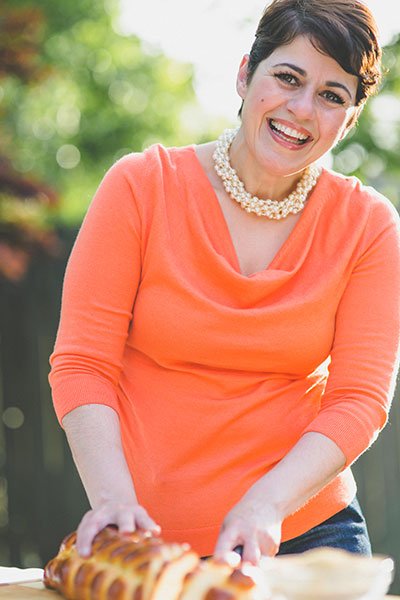
I love bread. I really, really do. I have been baking it in some form or fashion for over 35 years, starting out as a child on a stool next to my beautiful mama. So my bread making and eating infatuation began early in life and this challah bread was one of the first bread recipes that my mom taught me how to make. Needless to say I have never lasted more than five minutes on a carb free diet!
Ingredients:
¾ cup (6 oz) warm water, between 110-120 degrees
3 tablespoons sugar or honey (preferably organic local honey)
1 packet of active dry yeast
2 ¾ cups (366g) of King Arthur’s All Purpose Unbleached flour
1 teaspoon salt
3 tablespoons unsalted butter, melted and cooled
2 large eggs, beaten (preferably organic, free-range)
1 teaspoon of a mild vegetable oil such as canola
1 egg, beaten (preferably organic, free-range)
1 tablespoon water
¼ cup sesame seeds (optional)
How to use them:
Melt the 3 tablespoons of butter on high for 20 seconds and allow to cool.
In a glass measuring cup measure or weigh 6 ounces of water. Add the local organic honey to the water. Heat the water-honey mixture in a microwave for 30 seconds on high, that will bring you to a temperature of right around 115 degrees. Sprinkle the [glossary_exclude]yeast [/glossary_exclude]on top of the water-honey mixture and stir to combine. Proof the yeast by allowing it to rest for 15 minutes.
 In the meantime, in a large bowl combine the flour and salt in large bowl and whisk thoroughly. Make a well in the center and add the proofed [glossary_exclude]yeast[/glossary_exclude] mixture, the beaten eggs and the melted butter.
 Mix until just combined with a spatula, cover with plastic wrap and let rest for 20 minutes, allowing to autolyse.
Turn dough unto a lightly floured surface. I use this handy dandy shaker for flouring surfaces, it is the perfect tool for spreading the flour in just the right amount. These are the same shakers you find at your local pizzeria. If you ask very, very nicely with a sweet smile, they just might give it to you!  Knead by hand by [glossary_exclude]folding[/glossary_exclude] the dough over itself and using the palm of you hand to push the dough against the surface, pressing forward, [glossary_exclude]folding[/glossary_exclude] over once again and turning the dough slighly, approximately an eighth of a turn. Keep repeating this process.
 Knead for 10-15 minutes, adding more flour as needed, until smooth, pliable and the dough passes the window pane test.
  Once the dough is kneaded, shape it into a round by placing both hands around the dough and pushing the dough back and forth both between your hands while turning until you achieve a round shape.
 Place the dough into a bowl greased with the vegetable oil, turning the dough over to cover completely with the oil and cover with a plastic wrap. Proof the dough by allowing it to rest in a draft free area until double in size, for approximately for one hour.
After the dough has proofed, gently press the dough down with your open hand and [glossary_exclude]fold[/glossary_exclude] it unto itself, deflating. Repeat the [glossary_exclude]folding[/glossary_exclude] process three more times. Turn the dough onto a lightly floured surface. Divided the dough into 2/3 and 1/3 pieces. Roughly shape each piece in a log and divide once again into three equally-sized pieces.
 Take the larger three pieces and make into ropes by rolling against the surface, rolling until the ropes are approximately 3/4 inch in diameter. Repeat with the three smaller pieces of dough until the they are approximately 1/4 inch in diameter. The goal is to have all six piece the same length.
Begin braiding starting with the 3 larger ropes. When braiding dough, it is always recommended you begin the braid in the middle, braiding one half and then braiding the other half from the middle out once again. This techinique allows the braid to come out evenly, rather than large at the beginning and tapering at the end. Once you reach each of the ends of the braid, pinch the pieces together and tuck the end piece under. Lift the braided dough and place it on a half sheet pan prepared with either parchment paper or a Silpat silicon mat. Using the palm of your hand lightly press down on the braid to flatten slightly to prepare the dough for the additional smaller braid you will place on top of it
 Beat the egg and tablespoon of water together with a fork and use the mixture to egg wash the dough entirely. Egg washing this larger braid allows the smaller one to adhere to it.
  Lay the small braid over the larger one, centering it. Gently press down on the smaller braid to ensure adherence to the bottom loaf.
 Egg wash entire loaf and allow to rise in a draft free spot until double, approximately one hour. Do not cover. After 45 minutes of proofing, preheat your over to 350 degrees.
 After the dough has risen, egg wash once again. Be extremely gentle with egg washing as you do not want to deflate the gas bubbles that you have just formed through proofing. Sprinkle with sesame if you would like.
Bake at 350 degree for aproximately 25-35 minutes, until the crust is a dark golden brown and the bottom of the loaf sounds hollow when tapped.








Looks beautiful and delicious. And I love the idea of the pizza parlor shaker for distributing flour.
This Challah looks so gorgeous, I hope mine turns out as nice.
Beautiful Challah. I made it years ago… You have inspired me to do it again! I will block off time to do this! Wish you lived closer and could come teach in my cooking school. I Have enjoyed watching you and Francine on the baking competition. You have a natural knack for baking as she does. Love your blog. I will be here often!
Best,
Karen Abrams
Rolling the dough into ropes has proven to be my demise! Any tips on getting the ropes long enough and even enough? Mine snap in the middle or end up thinner in some parts, which makes the braiding look wonky. Perhaps too much flour? Too much butter? Help!